

If a scientific paper offers a counter-narrative conclusion, should it be deleted from the record?
Science publisher Elsevier says yes, if the topic is vaccines, because allowing doctors and parents to read it would pose a risk to public health.
This raises the question: Is censorship of science really the best way to ensure public health and safety?
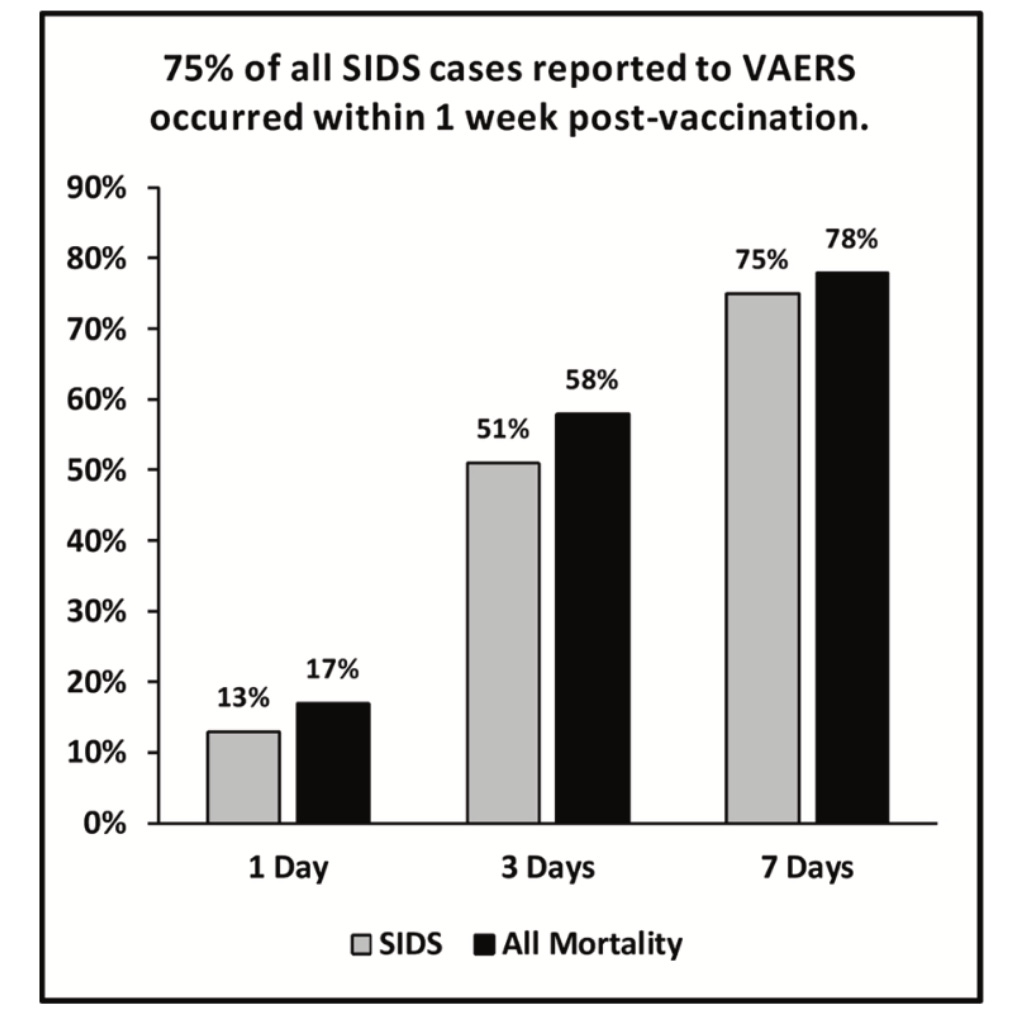
The paper under scrutiny is a peer-reviewed analysis of three decades of vaccine adverse event reporting data which found that 75 percent of sudden infant deaths occurred within seven days of a vaccination, a statistically significant finding.
Author Neil Z. Miller reviewed the medical literature linking SIDS (sudden infant death syndrome) to vaccines and proposed several pathogenic mechanisms, concluding that, “While the findings in this paper are not proof of an association between infant vaccines and infant deaths, they are highly suggestive of a causal relationship.”
The main finding from the paper, titled ‘Vaccines and sudden infant death: An analysis of the VAERS database 1990–2019 and review of the medical literature,’ is represented in the below image, which was widely shared on social media since its publication in the journal Toxicology Reports, in June 2021.
Nearly five years later, the paper has been removed, a highly unusual step reserved only for papers that may present legal risks to the publisher, Elsevier, or that could pose a serious health risk. Usually, serious concerns are dealt with either through the publication of a correction, an expression of concern or, in the most egregious cases, a retraction. Removal differs in that it essentially deletes the paper from the scientific record.1
According to a 9 April notice, the removal was triggered by reader complaints over “potential research errors and methodological flaws,” leading an investigation by the journal. The main sticking point was the use of data from VAERS (Vaccine Adverse Events Reporting System), a passive reporting system to which anyone can make a report, to infer a correlation between vaccination and SIDS.
The notice states that Miller’s response during the investigation “did not satisfactorily address” concerns raised. “In light of these concerns, and given the potential implications for medical practice, the Editor-in-Chief has decided that the article should be removed. The author disagrees with this decision and disputes the grounds for removal.”
In a further comment to Retraction Watch, an Elsevier spokesperson confirmed that the paper was removed because “the recommendations and conclusions presented in the paper may pose potential risks to public health and could potentially be applied in clinical practice resulting in harm to patients.”
This is striking given that paper explicitly states that “this paper does not prove an association between infant vaccines and sudden infant deaths.”
Miller qualified that because the article “reveals unusual patterns and safety signals highly suggestive of a causal relationship,” “additional investigation is warranted,” as well as “finding ways to increase vaccine safety, reduce inaccurate or inconsistent cause-of-death certification practices, and support families in their quest to make genuinely informed healthcare decisions.”
It is hard to see how any of these recommendations could do anything other than improve public health and clinical practice.
In an email, Miller told me that he “strongly opposed the removal of my paper,” calling the decision “unjustified.”

The problem with VAERS data
VAERS is the US national passive vaccine surveillance system, the purpose of which is to “detect possible signals of adverse events associated with vaccines,” according to the Centers for Disease Control (CDC).
Anyone can submit a report to VAERS — patients, caregivers, doctors, pharmacists, even lawyers. On the other hand, if a patient experiences a post-vaccine side effect and a report is not voluntarily submitted to VAERS, it is a proverbial tree falling in the forest with no witness.
Thus, VAERS captures reports of adverse events that occurred after vaccination, but it does not capture all adverse events and it cannot establish that the vaccine caused the event.2
The CDC states that correlation alone does not constitute a signal, and regarding SIDS specifically, that clustering deaths close to infant vaccinations is likely coincidental because, “At this age, infants are at greatest risk for certain medical events, including high fevers, seizures, and sudden infant death syndrome (SIDS).”
The fact is that public health agencies and their defenders want to highlight the limitations of VAERS when it benefits them, but gloss over them when it doesn’t:
VAERS data is unreliable, coincidental, and cannot constitute any meaningful signals.
At the same time, the existence of VAERS proves that vaccines are safe because authorities are monitoring it and would act on any meaningful signals.
Authorities and their sanctioned researchers are allowed to “investigate” correlations between VAERS reports and vaccines and produce findings that the vaccines had nothing to do with anything, but independent researchers are not to use the data at all.
As noted by Retraction Watch, Miller’s article is just one of a number of vaccine-critical studies featuring VAERS data that has come under scrutiny in recent years. These include one retracted by Cureus which called for a moratorium on mRNA Covid vaccines, and another retracted by Toxicology Reports which questioned, “Why are we vaccinating children against COVID-19?”
A third under investigation by publisher Taylor & Francis, was incorrectly described by Retraction Watch as “claiming to find DNA contamination in COVID-19 vaccines that was based on VAERS data.” In fact, the DNA contamination finding was based on lab work, however VAERS data provides specific lot information along with reports of medical incidents after vaccination, allowing the scientists to correlate batches with high DNA contamination reads with potential real-world impacts as reported to VAERS.
Cynics might speculate that it benefits the vaccine industry and public health agencies promoting vaccine uptake to keep VAERS exactly as is, limitations and all.
A 2007-2010 investigation into VAERS conducted by Harvard for the US Government which found that fewer than one percent of post-vaccine adverse events were reported to VAERS recommended that “proactive, spontaneous, automated adverse event reporting” linked with electronic health records and other information systems could improve the speed and accuracy of identifying the risks of pharmaceutical drugs.
Conspicuously, the researchers claimed that the CDC was "no longer responsive" to their “multiple requests” to continue the investigation, and a planned randomised trial comparing an improved surveillance system to the existing VAERS never happened.
No one in the US Government has since shown serious interest in improving VAERS until US Health Secretary Robert F. Kennedy Jnr. identified implementing recommendations from the Harvard investigation as a priority.
VAERS and SIDS
While VAERS data cannot prove a causal relationship between vaccination and SIDS deaths, Miller argues that temporal associations should be considered alongside potential biological explanations for any correlations that are apparent.
“The reason infants are at greatest risk for medical events at this age is precisely because they receive multiple vaccinations — that have never been tested in combination — at a time when their immune, neurological, and respiratory systems are still immature,” he told me (emphasis Miller’s).
Miller said that he acknowledged the potential of reporting bias — where parents and doctors may be more likely to report SIDS deaths closer to vaccination than weeks later — in the limitations section of his paper.
But that potential reporting bias should be taken alongside the biological plausibility of an “an incubation period,” whereby vaccinations can, according to various experts referenced in the paper, trigger a cascade of physiological responses that peak within 24-48 hours after vaccination.
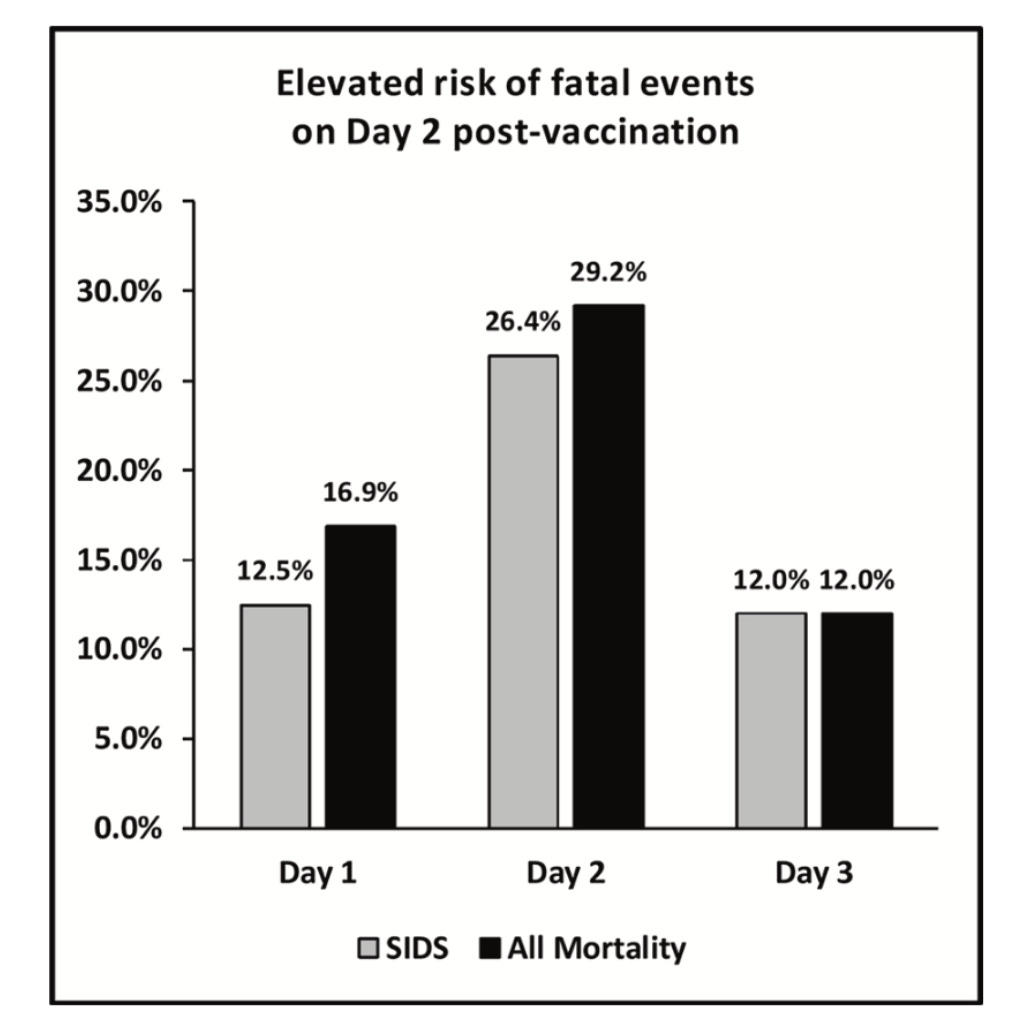
Miller said that the smaller proportion of infant deaths reported on Day 1 and Day 3 post-vaccination compared to the peak on Day 2 was statistically significant and “strongly suggests that reporting bias cannot fully explain the clustering of infant deaths and SIDS cases in the early post-vaccination period.” If parents were simply reporting deaths near vaccination opportunistically, you would expect Day 1 to have the most reports, not Day 2.
Moreover, Miller references seven studies and two confidential reports which display similar distribution of sudden infant death reports following vaccination, highlighting that this finding is not unique to his analysis of VAERS data. These studies comprise of passive data collection and case reports across multiple countries in relation to a range of different vaccines.
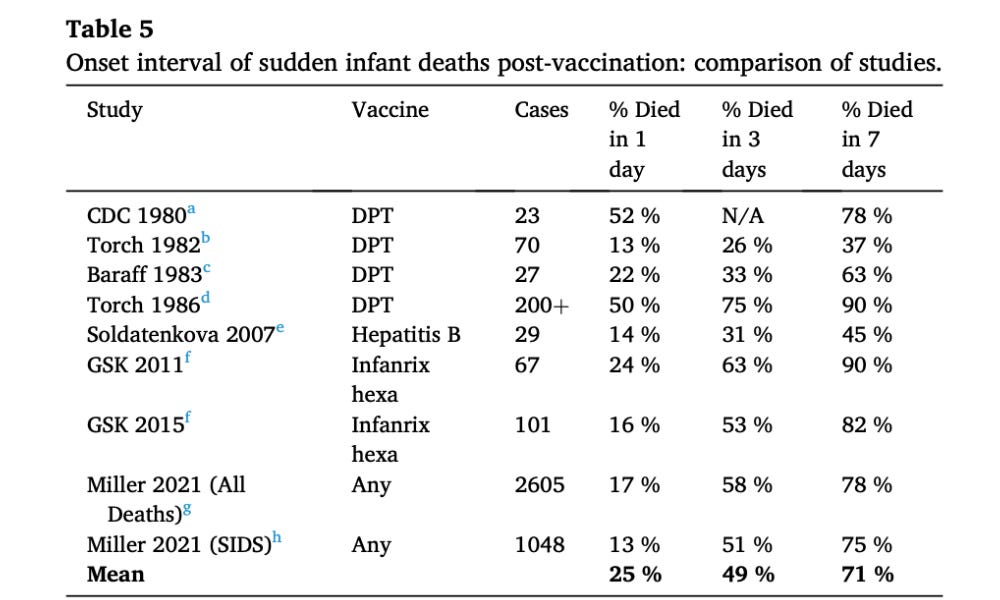
The GSK (formerly GlaxoSmithKline) confidential post-marketing surveillance data relating to the Infanrix hexa vaccine, from 2011 and 2015, is the most damning. Miller attests that the manufacturer’s own internal reports showed that 97 percent and 98 percent, respectively, of sudden infant deaths occurred in the first 10 days post-vaccination.
According to a critique published in the Indian Journal of Medical Ethics (Puliyel & Sathyamala, 2018) and cited by Miller, GSK in a sleight of hand calculated the comparative ‘expected’ rate of SIDS deaths according to doses distributed, not administered, thus likely inflating the expected rate of deaths. Also, no active surveillance was conducted, and deaths acknowledged in an earlier report were eliminated from a later one. GSK concluded that SIDS deaths did not exceed the expected rate and that its vaccine was safe: regulators accepted this at face value.3
On the subject of expected background rates, Miller acknowledges that population-level SIDS rates would be a useful comparative metric, but notes that with immunisation coverage above 90 percent in the US, a meaningful unvaccinated baseline is challenging to quantify.
Miller also acknowledges that while some studies have found a correlation between vaccination and SIDS, other studies have not. One wonders if any papers in the latter category have been subject to campaigns for their deletion from the scientific record.
Timing suggests social media popularity was a factor in removal
According to Miller, whose LinkedIn page says he is a psychology graduate who has been researching and publishing on vaccine safety for some forty years, the complaints he was asked to respond to were brought from a single person soon after publication.
However, Miller was not notified of the complaints until December 2025. During that year, high-profile vaccine-skeptics Dr Peter McCullough and Dr Pierre Kory shared posts about Miller’s paper on their Substacks and discussed its findings on social media. The image at the top of this post showing the clustering of SIDS deaths within days of vaccination in particular was shared widely on social media sites.
In February 2026, Miller was informed by the publisher, Elsevier, that despite his thorough responses to concerns raised, Editor-in-Chief Professor Lawrence Lash had decided that the findings of the article “constitute potentially unsafe research for medical practice,” warranting a removal rather than a correction.

Is the Editor seriously suggesting that medical practitioners are too stupid to understand what VAERS is, and how the data should be weighed alongside other scientific data and in the broader context of the scientific discourse around vaccines and SIDS?
Lash, the Founding Editor of the journal, is a highly-cited Professor of Pharmacology at Wayne State University. It is unlikely that he genuinely believes his peers are so dumb.
More likely, this was a political retraction. Prior to its removal, Miller’s paper had been cited only 12 times in the scientific literature, according to Semantic Scholar. Its primary impact was clearly in the public sphere, not the scientific.
If this is the case — and we have seen journals remove valid peer-reviewed articles before due to social media virality, as I have previously reported — then this is yet another instance of politics dictating the bounds of scientific discourse.

It’s worth noting that the Editor-in-Chief of the journal at the time of the article’s peer-review and publication was not Professor Lash, but the extraordinarily highly-cited Greek Professor of Toxicology Aristidis Tsatsakis, senior author on the aforementioned and now retracted article, “Why are we vaccinating children against COVID-19?”
Professor Tsatsakis said in an email that he believed his paper had been “retracted unjustifiably” due to “the policy [of] that period.” He noted that he has published several books with Elsevier which is a “huge publisher” and that “people representing Elsevier at various times can do mistakes.” He characterised Professor Lash as a reputable scientist who acted as a “kind of yes Sir” Editor-in-Chief under these circumstances.

The Streisand effect strikes again
Obviously, the purpose of removing or retracting a scientific paper is to delegitimise it. The fact that trust in science, public health, medicine, and the media is in decline suggests that the target audience for this kind of tactic is shrinking.
In fact, striking a paper from the scientific record can have the opposite effect, said Dr McCullough, who has himself been subject to apparently political retractions.
“We have found that retraction of valid papers results in greater awareness of the manuscript, more reads, downloads and citations, and intensified concern over bias and bio-pharmaceutical capture of the peer-review publication process,” Dr McCullough told me over email.

It is certainly the case that retracted papers can become internet lore, with the effort to suppress them creating a Streisand effect and sometimes propelling the authors into the social media influencer-sphere.
Dr McCullough is case in point: Several Covid vaccine-critical papers on which the prolifically cited Dr McCullough was a contributing author have been withdrawn or retracted. His board certifications in internal medicine and cardiovascular disease were recommended to be revoked by the American Board of Internal Medicine for “casting doubt on the efficacy of COVID-19 vaccines,” though Dr McCullough says he resigned before any revocation took effect.4 Yet, his social media popularity continues to increase. He now boasts a following of 1.2 million on X and 137,000 subscribers on Substack
Nevertheless, not all authors are so naturally able to turn to social media to communicate their message to a more receptive audience. It is frustrating to authors who labor to contribute to the scientific discourse to have their work excluded. Papers citing articles that have been retracted or withdrawn must update their references accordingly, and the authors’ records are stained.
Most importantly, science cannot progress when inconvenient findings are deleted from the record.
Scientists, medical professionals and parents should be able to read about what VAERS data show, and Neil Z. Miller’s analysis of what this means for vaccination and SIDS. They should also be able to read rebuttals of Miller’s work in the peer-reviewed literature.
Unless science is a religion with unquestionable dogma, in which case Miller’s paper should be deleted and the catechism “we believe in vaccines” published in its place.
Miller is now turning his attention to a book, which will include the study removed from Toxicology Reports, and will give insight into the removal process with the publication of Miller’s correspondence with the Editor-in-Chief and a representative of Elsevier’s ethics committee.
Miller has previously published the books Vaccines: Are They Really Safe and Effective? and Miller’s Review of Critical Vaccine Studies: 400 Important Scientific Papers Summarized for Parents and Researchers.
The paper ‘Vaccines and sudden infant death: An analysis of the VAERS database 1990–2019 and review of the medical literature’ by Neil Z. Miller (2021) is embedded in PDF form below. Feel free to download and share.
Children’s Health Defense did a good summary of the paper which you can read here.

Amendment Tuesday 2 June 2026: This article has been amended to note that Dr McCullough disputes that his certifications in internal medicine and cardiovascular disease have been revoked by ABIM.
Elsevier’s article withdrawal policy states that “Elsevier’s official archives at the National Library of the Netherlands will retain all article versions, including retracted or otherwise removed articles.” However, this archive is not accessible to the public and so in effect, an article that has been removed from an Elsevier journal is deleted from the scientific record.
Australia’s Database of Adverse Event Notifications (DAEN) functions in more or less the same way, but for all medicines, not just vaccines. Most developed countries rely on passive surveillance systems of this nature for ongoing safety monitoring once a medical treatment goes to market.
Data from the DAEN combined with data from the TGA’s internal database, the Adverse Event Management System (AEMS), shows that at least 43 infant deaths have been reported to the Australian regulator following vaccination with Infanrix hexa as at October 2024, since its approval by the TGA in 2006. The AEMS data is not visible to the public, but was released under Freedom of Information (FOI 1345-01). Independent journalist Maryanne Demasi reports that the TGA refused to answer media questions about whether it had investigated the deaths.
Dr McCullough says that he maintained certification through November 11, 2024, when he voluntarily resigned with all rights reserved by legal notification and signed certified letter to ABIM. His resignation letter was accepted by ABIM CEO Dr Furman McDonald c/o Ganae Powell certified article #70221670000174699230. ABIM bylaws do not allow revocation of certification after resignation. As of April 30, 2026, the US Health and Human Services National Practitioner Databank indicated no action has been taken against certification. Dr McCullough holds the National Board of Physicians and Surgeons Certification NBPAS ID: N57647 in Internal Medicine and Cardiovascular Diseases, March 1, 2024 valid through March 31, 2028. He is licensed to practice medicine in Texas, Michigan, Missouri, Colorado, Florida, and Washington.
Another peg in the 'public trust' coffin.
My sister died of SIDS in 1974. That was all I knew growing up. No one really talked about the why and I didn’t think anything of it.
One day many, many years later, I asked my mother if she still had my sister‘s baby book and she did, and lo and behold she received a DTP vaccine three days before her death!